


Experts Warn Central Asia Risks Missing Another Chance as Trans-Afghan Routes Gain Momentum
ASTANA – Geopolitical factors have pushed Central Asia to rethink its transport and logistics geography. Regional analysts say Central Asia is facing a rare opening to reshape its connectivity through Afghanistan, but warn that the absence of a unified strategy could once again turn the Trans-Afghan agenda into a missed opportunity.
Regional experts highlighted practical steps for the region as it deepens its engagement with Afghanistan at a Nov. 20 roundtable organized by Cronos.Asia think tank.
“There is significant skepticism about how much Afghanistan can be trusted, especially when it comes to the Taliban. But our engagement from Central Asia is not about supporting the Taliban, it is about supporting the people of Afghanistan, who have endured more than 40 years of geopolitical upheaval,” said political expert Eldaniz Gusseinov.
“When the Taliban came to power, there were countless predictions about how long they would be able to stay afloat,” he added.
During that period, the country faced severe challenges, including a nearly 40% drop in GDP, a major food crisis, a series of earthquakes, clashes along the Afghan-Pakistani border, a trade deficit and blocked access to external markets.
Yet the Taliban remained in power. One of the key factors, Gusseinov said, was their effort to restore the functioning of border crossings and reduce corruption and informal payments in transit operations.
“As Afghan researchers have noted, the Taliban were able, if not to eliminate corruption entirely, then at least to significantly reduce it and to streamline the work of border checkpoints. There were fewer informal payments for transporters. As a result, cargo from Central Asia began moving more actively through Afghanistan toward Pakistan and Iran, allowing Afghans to earn income,” said Gusseinov.
Why Central Asia needs Trans-Afghan projects
Outlining his arguments in favor of advancing the Trans-Afghan corridors, Gusseinov stressed that the more Afghanistan is integrated into Central Asia’s economy, the lower the risk of radical destabilization. Transit provides income for the population, creates jobs, and builds the minimal economic foundation without which any political stabilization is bound to fail.
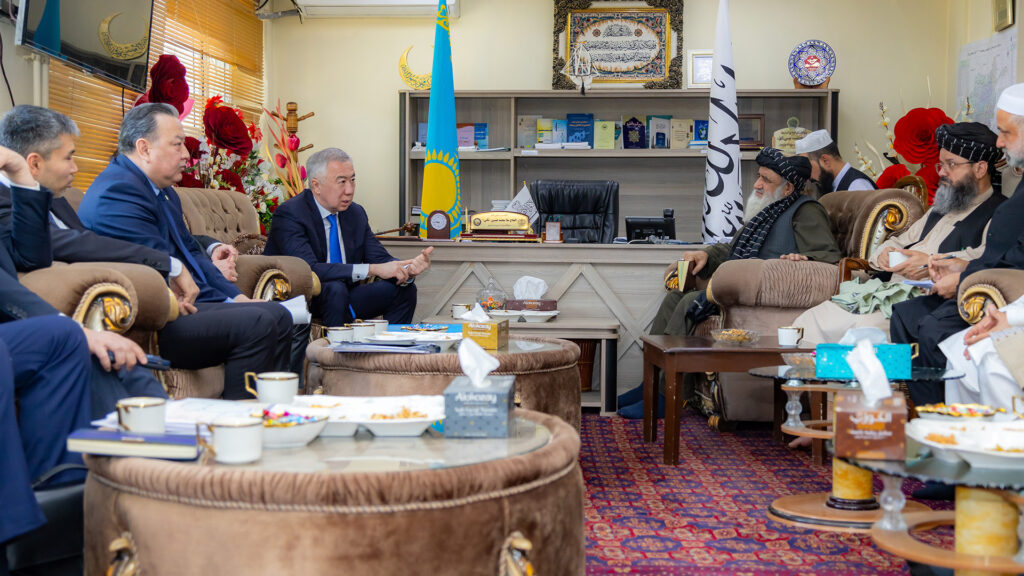
In April 2025, during the visit of the Kazakh delegation headed by Deputy Prime Minister and Minister of National Economy Serik Zhumangarin to Afghanistan, Kazakhstan and Afghanistan confirmed they are interested in participating in the construction of the Turgundi – Herat – Kandahar – Spin Boldak railway. Photo credit: primeminister.kz
According to him, up to 90% of Afghanistan’s electricity comes from countries of the region. A substantial share of its flour, grain and cooking oil is also imported from Central Asia.
“Therefore, it is critically important for us to develop projects [with Afghanistan], so that people in Afghanistan can transform their economy and solidify engagement with us,” he added.
“What I mean is that we can still work with Afghanistan. Given that it is a huge market of 40 million people, we can develop in parallel and build mutually beneficial cooperation. Two middle powers, Kazakhstan and Uzbekistan, are attractive partners for Afghanistan precisely because it does not have to engage with major geopolitical players. This question has become especially relevant after the cancellation of the oil extraction deal with China in the Amu Darya basin,” said Gusseinov.
There is also a national security dimension to consider. “The national security dimension, however, concerns Turkmenistan more directly. Turkmenistan exports gas and primarily to China. This is why TAPI is of critical importance for Turkmenistan: if China ever stops purchasing Turkmen gas, the impact on Turkmenistan’s economy would be devastating,” he said.
TAPI is a 1,814-kilometer pipeline, 816 kilometers of which run through Afghanistan, and is expected to transport 33 billion cubic meters of gas annually. The project is designed to deliver Turkmen gas to energy-deficient markets in India and Pakistan.
Dilemma
While explaining all the factors, Gusseinov, however, posed one question.
“For all their advantages, these initiatives contain a fundamental contradiction: by developing Trans-Afghan projects, Central Asia simultaneously helps stabilize Afghanistan as a state and strengthens the Taliban’s authority, a regime many do not consider legitimate or a desirable partner,” the political analyst explained.
Experts agreed there is no simple yes-or-no answer. Yet the deeper the interdependence, the greater the region’s leverage over Kabul, from water and electricity to trade and transit.
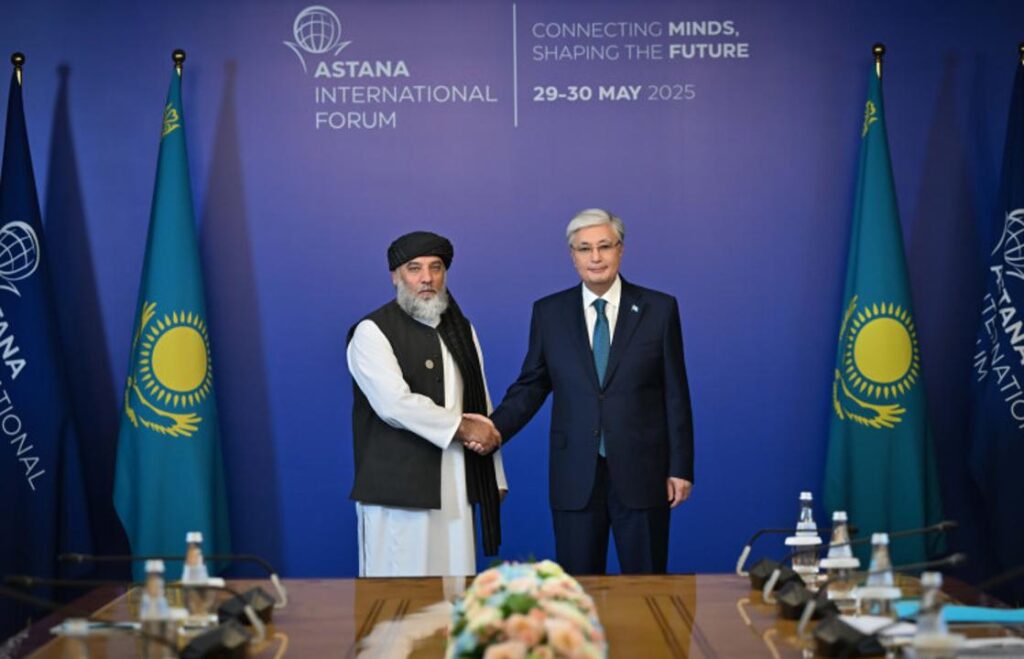
Nooruddin Azizi, the acting Minister of Commerce and Industry of Afghanistan, met President of Kazakhstan Kassym-Jomart Tokayev in Astana in May 2025. Photo credit: akorda.kz
Need for Central Asia’s coordinated position
Aidar Borangaziyev, director of the Astana-based Open World analytical center, stressed that the real test lies not in choosing routes or projects but in whether Central Asian states can form coordinated positions.
“What matters most is whether Central Asian countries can develop coordinated positions, avoid internal competition, and strengthen their collective diplomatic weight. I believe that this alignment of approaches will determine the success of all Trans-Afghan projects, no less than the infrastructure itself,” said the expert.
Key corridors
Borangaziyev said public discussion of Afghan transit still treats the issue through an outdated lens, assuming that Trans-Afghan logistics is essentially the Kabul line. That view, he said, is a legacy of an earlier period and no longer reflects the reality on the ground.
The Kabul line, also known as the eastern route from Mazar-i-Sharif via Kabul and Peshawar towards Pakistani ports of Karachi and Gwadar, however, has its own geographic and security constraints. They include challenging geography as the route requires crossing the Hindu Kush, an 800-kilometer-long mountain range in Central and South Asia to the west of the Himalayas, navigating high-altitude terrain, and building expensive, technically complex infrastructure. It is also characterized by volatile security, stemming from the activity by the Tehrik-e-Taliban Pakistan (TTP), and narcotics and criminal networks.
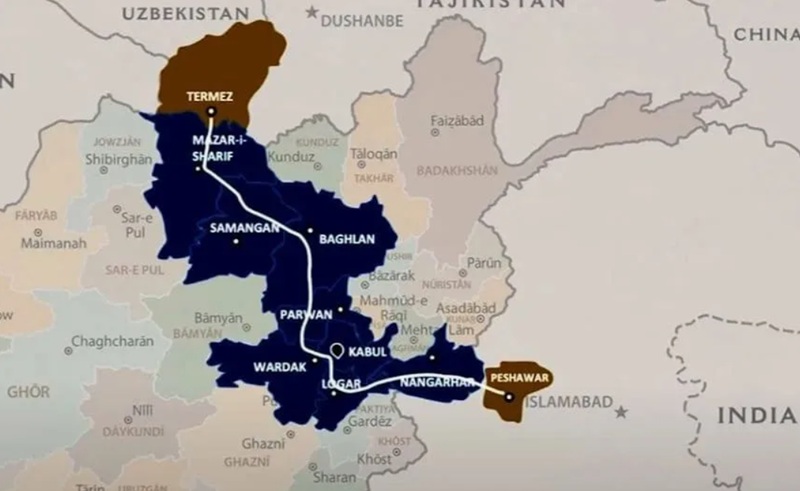
The Kabul line. Photo credit: daryo.uz
The second, and what Borangaziyev sees as the more strategic option, is the western route, stretching from Mazar-i-Sharif toward Herat, Kandahar and Spin Boldak, and onward through Pakistan to the port of Gwadar. This line also includes the Turkmen segment, where Kazakh companies are involved in construction and investment, the stretch from the Turkmen border at Torghundi to Herat.
“In its broader definition, the western route also includes Iranian transit. From the area of Afghanistan’s Delaram in Nimruz Province, the corridor can turn southwest toward Iran’s Zahedan and then continue directly to the well-known port of Chabahar [in Iran],” he explained.
Another vital element, which, according to Borangaziyev, is often missing from discussions, is the Five Nations Corridor, a proposed international route linking China, the Kyrgyz Republic, Tajikistan, Afghanistan, and Iran.
“When it comes to the Five Nations Corridor, its significance for Central Asia is hard to overstate,” Borangaziyev said.
“This route gives Tajikistan and Kyrgyzstan a real physical link not only to Afghanistan but further to Iran and the southern seas. Uzbekistan maintains strong logistical positions, but within a more flexible and diversified transport configuration. Kazakhstan and Turkmenistan gain an additional southern vector that strengthens their connectivity within a broader macro-regional system. As a result, the western route emerges not as just another line from point A to point B, but as a key node in Eurasia’s infrastructural architecture,” he explained.
In the short and medium term, he believes the western route through Herat and Iran is the most realistic and viable option for developing Trans-Afghan connectivity.
Sensitive issue
Borangaziyev cautioned against the potential indirect influence of the U.S. administration policies, including the sanctions regime against Iran.
“They are capable, if they want, of shifting the balance between the western and eastern routes. Although the Americans do not participate directly in infrastructure projects, they possess enough diplomatic, financial and military leverage to recalibrate the regional transit logic in line with their own interests,” said the expert.
What does an opening to the south mean for Central Asia
Sherali Rizoiyon, a political scientist from Tajikistan, reminded his colleagues that discussions about Trans-Afghan integration have been underway for more than 10 years, long before the Taliban came to power.
“At the conceptual level, Trans-Afghan projects represent one of Central Asia’s missed opportunities, something our countries should have acted on 20 years ago,” Rizoiyon said. “Today, these projects certainly create both challenges and opportunities.”
The first challenge, he noted, is whether five Central Asian states are ready to rethink their geopolitical mindset and to open themselves to the south.
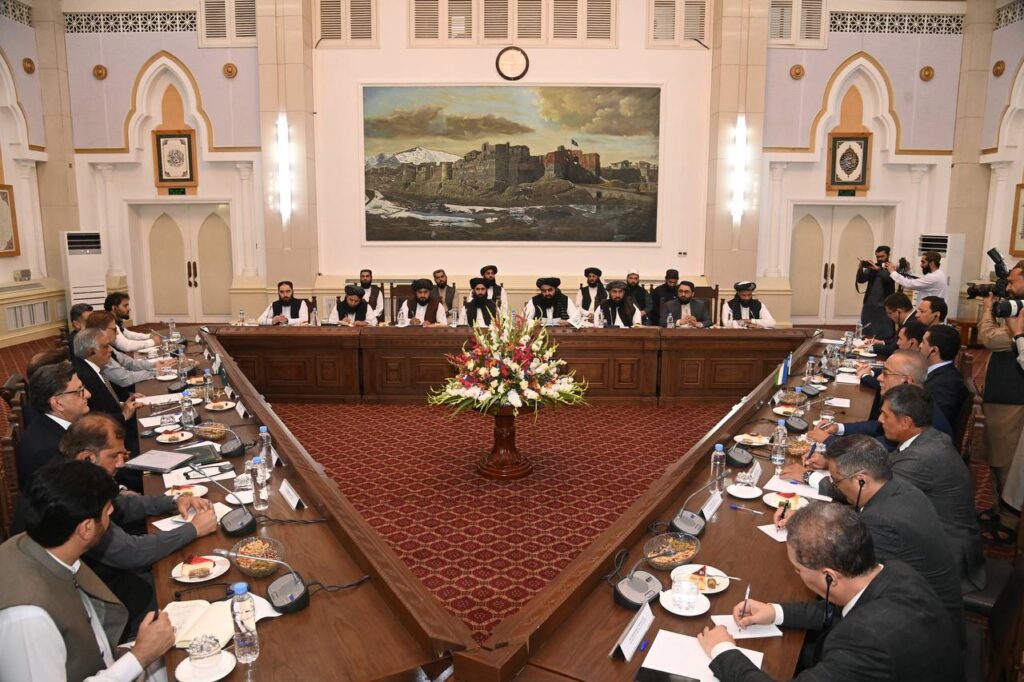
The first trilateral meeting between the foreign ministers of Uzbekistan, Afghanistan, and Pakistan in July 2025 in Kabul, where they signed a tripartite framework agreement to develop a feasibility study for the Trans-Afghan railway project. Photo credit: Uzbek FM Bakhtiyor Saidov’s Telegram channel
“This is an enormous geopolitical challenge, because it breaks traditional routes and fundamentally changes the region’s strategic weight. Whether through Iran or Pakistan, gaining access to the southern seas would completely reshape Central Asia’s geopolitical position,” he said.
Other challenges entail reassessing foreign-policy priorities, balancing among competing actors, and developing a proactive rather than reactive regional posture.
“For many years, we have seen that any project that strengthens Pakistan’s position in Afghanistan immediately triggers counteraction from Iran and vice versa. There is also the Indian factor,” Rizoiyon said.
Repeated scenario
Rizoiyon echoed his colleagues, underscoring the importance of Central Asia’s coordinated actions on the Trans-Afghan projects. Experts agreed the region is not yet ready to view Trans-Afghan routes as a unified Central Asian project.
Several parallel initiatives currently exist, including Uzbekistan’s route from Termez toward Herat and Pakistan, Kazakhstan’s project through Turkmenistan and onward to Iran or Pakistan, and the Tajikistan–Afghanistan–Turkmenistan railway, which has been under discussion for more than a decade.
Rizoiyon warned that if every state continues pushing only its own route, the Trans-Afghan agenda will once again become a missed opportunity.
“There should be a common approach. If Central Asian states compete over who is in charge, it will repeat the missed opportunities of the 2000s,” he said.
If this dynamic persists, he noted, the region’s long-awaited access to the sea may be postponed yet again and possibly for a long time.
Источник: astanatimes.com